Pyramaze
The Beginning: I developed my first ever mobile game called DodgeWall. It is a simple tap to dodge game that is easily learnable without any instructions. One day, I showed this game to my dad and he was excited, he loved the intensity and the idea of dodging falling walls just by tapping side to side on the phone. He started telling me about the game that he used to play in our old computer more than 20 years ago. The game was called Mummy Maze. I remember watching him concentrate and play it night after night and celebrate small wins everytime he clears a level. For the next few days, every time I showed him a new feature or game I have created, he'd unknowingly and happily circle back to telling the story of his old game.
Seeing him happy about recalling the nostalgia of playing the game, I realized he wasn't just talking about a game; he was talking about a feeling. He missed that distinct mix of strategy and claustrophobia you get when the monsters are closing in while he tries to calculate his next move. Knowing I have enough skillset to build the mechanics, I decided to build a version that could trigger the same feelings and happiness he had more than two decades ago.
The Design: I did some research and saw some clips and photos of the original game and was thrilled at the thought of developing a new game, this time a puzzle game which I have never ever done before. Seeing the old clips and photos of the original Mummy Maze, I realized something: Even tho the game was fun and nostalgic and entertaining, there are some constraints that I would be facing when designing a grid based game.
There is no question that the game I will be creating would be using a mobile first approach. With this consideration, a myriad of challenges was immediately obvious to me.
First of all, as levels go higher, the grid gets bigger in column and row. This is already a huge wall for a level progression based game because there is only so much space on a mobile device screen and the elements of the game can only be minimized to a certain reasonable extent until it is unplayable and unfun to use.
Second, the controls and progression should be the same across devices no matter the device resolution or brand. As we all know today, different phones have different screen sizes and this is a constraint that has plagued designers for more than a decade since the advent of mobile web design. The original Mummy Maze game had the freedom to create more than 10 rows for their grid but it is not feasible and irresponsible for me, and most importantly would be unplayable to players if I create a grid that would exceed that. The things and stuff would be so tinyyy.
The conclusion I had at the end of all this brainstorming is: "That was a fun design back then but it wouldn't survive the standards of today." I then decided to formulate a modern and minimal version that could build the experience of the old puzzle in a new and more easily accessible way.
The idea is to create a new gaming experience inspired by the puzzle mechanics of the original game as well as the true origins of the logic maze which was called "Theseus and the Minotaur" created by Robert Abbott back in 1990.
The Goal: I researched and learned how the original maze puzzle of Robert Abbott worked, and how the similarities of the Mummy Maze game have with it, and learned the core mechanics of the puzzle. The Goal now is to create an easy to understand with almost zero if not zero explanation at all kind of puzzle to reduce the friction of hopping in and trying it out.
Steve Jobs once said: "Design is not just what it looks like and feels like. Design is how it works."
A very good wisdom when it comes to design, and since the workings is just as important as the looks and feels, I also live by the idea that, good design should be intuitive and should not require an explanation.
The Game: Now that I have the mechanics, the algorithm, the constraints, and the design, I now have a general idea of how the game should look and work.
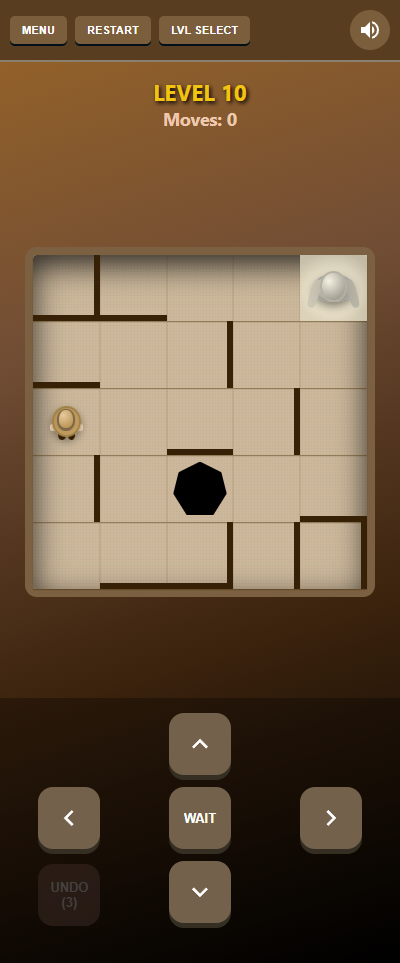
The Starting overlay contains the most basic design you need in order to begin, A logo at the very top and a short tagline underneath, a "New Game" button to start the game as a fresh player, and "More Games" button that leads to the studio website. Once a player reaches level 2 or higher, only then does more buttons are added to the starting screen in order to not overwhelm them in the beginning.
The controls should be very obvious, so it was intentional that it occupies a huge part of the bottom of the screen closest to the fingers of the users. The other half of the screen is dedicated for the grid system that would act as the window to the game world and its mechanics. The last small space at the top is reserved for important menu options and a bit of level and move count indicator to easily see the player's own progression.
The Progression: Obviously with all this constraints, it would mean that I cannot design the obstacles in the same way that Mummy Maze or Theseus and the Minotaur did in their own respective versions. The progression now for Pyramaze is dictated by the limitations of the visual dimensions of mobile devices we have today.
I myself tested a 12x12 grid version of the game and I was like: "What is this, a game for ants???" so yea that didn't really go according to plan. Although the game worked, it felt so cramped and unfun. Despite the limited screen size, I was able to design a leveling system that would allow the player to enjoy and experience the game up to 200 levels while still keeping it resonably fun and engaging and not very tiny looking.
Ending notes: This is my first puzzle game I have ever created in my entire life. Although I did not invent the core theory in the movements of the entities(players & monsters), I am proud to say that I have successfully created a fully functional, entertaining, fun and enjoyable game. How did I know it was fun? My dad played it nonstop for 3 days everytime with a smile on his face, and he said "It brought back the feeling I had when I was playing the old Mummy Maze game". And that was enough proof for me that I have succeeded in creating a fun game.